Friday, March 19, 2010

JPMorgan Sells Debt: Credit Markets - Bloomberg.com

Lengthen those liabilities.

* * * * * J B K * * * * *

San Francisco

March 19 (Bloomberg) -- Financial company bonds are beating industrial debt by the most this year after lagging behind in February, encouraging investors to snap up new issues from JPMorgan Chase & Co. and Credit Suisse Group AG.

Debt sold by banks, insurers and brokers returned 0.81 percent this month through yesterday, compared with 0.4 percent for the rest of the market, according to Bank of America Merrill Lynch index data. The cost to borrow for banks is the lowest since February 2008, with yields falling to within 1.93 percentage points of Treasuries on March 18.

http://www.bloomberg.com/apps/news?pid=20601087&sid=abb54OIrjRFc&pos=6

Wednesday, March 17, 2010

Bank Regulators Issue Guidelines on Liquidity Risk (Update1) - Bloomberg.com

Our analysts are studying these reports and will have a comprehensive analysis for clients in a week or so.

There is nothing in either of these reports to immediately concern decision makers.

* * * * * J B K * * * * *

San Francisco

March 17 (Bloomberg) -- The Federal Reserve, the Office of the Comptroller of the Currency and four other bank supervisory agencies released guidelines for liquidity risk management to deter the funding practices that contributed to the financial crisis.

"Given the recent market turmoil, the agencies are reiterating the importance of effective liquidity risk management for the safety and soundness of financial institutions," the agencies said today in a release. The guidelines emphasize the need for diversified funding sources, stress testing and a contingency funding plan, they said.

The Fed and other banking supervisors are reasserting their existing authority without waiting for Congress to complete an overhaul of financial regulation. The agencies are raising standards for capital, liquidity and risk management, and increasing their control over compensation policies. In January, regulators issued guidance on managing interest rate risk.

http://www.bloomberg.com/apps/news?pid=20601087&sid=arGN45fk0JMQ&pos=4

Wednesday, March 10, 2010

The war on banks continues

It's bad enough that big banks are getting hit with new regulations, fees, and taxes.

Now community banks are feeling the same squeeze.

The problem is the administration in Washington.

They want the banks and related institutions to pay for the mortgage market blunders committed by the Congress and the regulatory agencies.

Economic growth will be hampered by the unwillingness of small banks to make loans.

* * * * * J B K * * * * *

San Francisco

"We're hearing complaint after complaint," said Chris Cole, senior regulatory counsel for the Independent Community Bankers of America, speaking last week at the National Association of Attorneys General convention in Washington.

Bankers say a downgrade forces an institution to put more money in reserves, makes them reluctant to loan money and increases their FDIC premiums.

Those consequences are among the chief reasons many small businesses are finding it difficult to borrow money from their local, small banks, said Cole, whose group represents about 5,000 community banks with about $1 trillion in total assets.

http://legalnewsline.com/news/225958-community-bankers-decry-overregulation

Tuesday, March 09, 2010

Getting short the bond market

In the months to come there will be many opportunities to short the bond contract.

One of the best opportunities is provided by US Treasury auctions.

We are now in the middle of a $13 billion long bond auction.

Pay close attention to the way bonds trade for the next week or so.

Paterson advised clients to sell bonds at the 117.16 level with a 16 tick stop.

Traders will close out the position on the next major sign of weakness.

* * * * * J B K * * * * *

San Francisco

Money Numbers

The money supply is not going down.

MZM looks like its bottoming.
M1 is growing.
M2 is still weak.

Test

There has been a problem posting to this weblog.

* * * * * J B K * * * * *

San Francisco

Saturday, February 27, 2010

Market Roundup

Summary
  • Correction in the stock market is over.
  • Money supply still not growing
  • Inflation begins
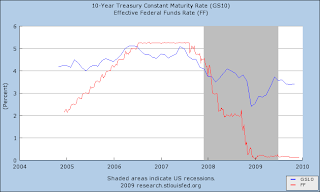
  • Interest rates not rising
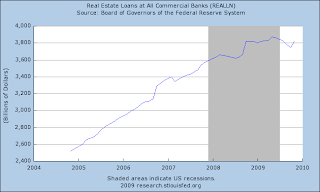
  • Bank lending still falling
  • GDP soars
  • Business cycle growth continues
  • Stock market in orderly move higher
  • Government stimulus continues
  • Dollar mixed
Money Supply
The following three graphs tell the story.  M2 and MZM are still slowing. Only M1 is growing, and that is probably due to increases in the Base. Banks are not lending.


Monetary base continues to grow.


Inflation
The first signs of inflation came with the PPI for December with an increase of 1.4% for the month.

The CRB trend has resumed its upward path.

 
 GDP Soars
Economic growth continued this past quarter at increased at an annual rate of 5.9 percent in the fourth quarter of 2009 . In the third quarter, real GDP increased 2.2 percent.

Price deflators are still benign.

Leading Economic Indicators signaled continued growth last week.

Stock Market
The stock market punched through resistance and made new highs for the move, heading for a resumption of the uptrend.

European investors poured money into US equities again this week, abandoning their own stock markets in favor of American investments.

Tactics
Money market arbitrage gets harder and harder as spreads collapse and competition increases. To achieve even a 100 basis point spread between liabilities and assets requires taking on credit risk. The money market desk will earn its pay in the coming months.

Strategy
 So far, the strategy of shortening asset maturities and lengthening liabilities has worked nicely. Keep doing it.


Tell the board it's time to find some credit worthy borrowers.


Make sure hedging operations are in place. Give the long bond desk a small position and encourage day trading: buying at support and selling at resistance. Get ready for the big short. It's coming.
 

Tuesday, February 23, 2010

Bank lending continues to fall


* * * * *  J B K  * * * * *

     San Francisco

Saturday, February 20, 2010

Time to Sell Bonds

The disaster in the bond market gained a new wreck this week with the release of the PPI.

An increase of 1.4% in one month is a warning to fixed-income investors that the inflation is back, and will build as the economy expands and banks resume lending.

Bonds are at the lows of a recent trading range and are poised to trade lower.

The following events will trigger a sell-off in bonds.
  1. Money supply increases - M1, M2, MZM
  2. Price increases - PPI, CPI, CRB
  3. Quarterly refundings - 10 year notes and 30 year bonds
If your institution has the ability to lengthen liability maturities, do it now.

If your institution is selling bonds during one of these events, make sure you're hedged.

* * * * *  J B K  * * * * *

     San Francisco

Sunday, February 07, 2010

Correction time for stocks

How big will this correction be?


Right now, we are at minor support: 1090 on the S&P 500.

If we drop below this level, the correction will continue for another 60-120 points.

At least.

At most, we could see a return to the lows of last March: somewhere in the 875 range.

This is not entirely implausible.

Recall the bottom back in 2002-3. There we saw a return to the same levels three times.


It could happen again, and for one simple reason.

The Federal Reserve will be selling bonds for the near future at a record clip, not buying them as they did during the last year.

Combined with US Treasury sales, the bond market will be under constant selling pressure for years to come.

Interest rates will rise.

As interest rates rise, the value of stocks must pause until rates settle down.

That is the situation facing us now.

SUMMARY
We are still in a bull market, and the bull market will continue.

But, be careful about adding new positions in the equities area.

Consider shorting this market if it drops below 1090.

Evaluate short positions every three days.

TACTICS
  • Money market arbitrage is still the best option for spread bankers.
  • Extend the maturity of liabilities
  • Find credit worthy borrowers.
STRATEGY
  • Tell the board that long rates will be rising
  • Short rates will not be rising
  • Credit spreads will be narrowing
  • Consider fee-based income alternatives

Thursday, February 04, 2010

Factory orders rose 1.0 percent in December | Reuters

WASHINGTON (Reuters) - New orders at factories jumped by an unexpectedly large 1 percent in December despite a drop in transportation equipment orders, while inventories shrank, a government report showed on Thursday.
Analysts polled by Reuters expected orders to increase by 0.5 percent. Factory orders for November were revised up to a 1 percent gain.
Transportation orders fell by 0.5 percent on a 34.1 percent drop in civilian aircraft orders. Excluding transportation, new orders rose 1.2 percent in the month.
Inventories fell for the first time in three months, dipping 0.1 percent.
The inventories-to-shipments ratio slipped to 1.29, the lowest since August 2008.
http://www.reuters.com/article/idUSTRE6133IB20100204

The business cycle rolls on. 

* * * * * J B K * * * * *
      San Francisco

Geithner: Banks must pay fully for bailout | Reuters

WASHINGTON (Reuters) - The Obama administration is prepared to impose fees on financial firms for as long as necessary to ensure that every cent spent on bailing out banks is repaid, U.S. Treasury Secretary Timothy Geithner said on Tuesday.

Barack Obama

A proposed Financial Crisis Responsibility fee that is projected to raise $90 billion over 10 years could be extended if the cost of the bailout exceeds that amount, Geithner said in testimony before the Senate Finance Committee.

"The fee can and will be extended until every penny of taxpayer assistance to the financial system has been repaid and the cost of the rescue to taxpayers is zero," Geithner said.

http://www.reuters.com/article/idUSTRE6113IB20100202


* * * * * J B K * * * * *

San Francisco

James B. Klein
Paterson Financial Services

WEBSITE: paterson.com
WEBLOG: paterson-financial-services.blogspot.com
NEWS WEBLOG: paterson-financial-services-news.blogspot.com

Saturday, January 23, 2010

Business Cycle Indicators

Leading Economic Indicators jumped 1.0% in the past month, with strength coming from 8 of the ten measures.


Only the average workweek of production workers and manufacturers’ new orders for consumer goods and materials* held steady in December.

A further confirmation of the power behind the Fed's increase in the monetary base, the increase in LEI foreshadows changes in aggregate economic activity.

Coincident Economic Indicators also increased in December and it has gained in five of the last six months. Industrial production made a large positive contribution to the index, more than offsetting the decline in employment in December. Between June and December, the index has grown by 0.6 percent (1.2 percent annual rate).

Observers will note that employment continues to lag more than usual, in both LEI and CEI numbers.

The Lagging Economic Indicators (LAG) have started to bottom, but we are still a long way from a full recovery.

The only positive contributor to the index this month was change in labor cost per unit of output*. The negative contributors – beginning with the largest negative contributor – were commercial and industrial loans outstanding*, average duration of unemployment (inverted), and ratio of consumer installment credit to personal income*. The ratio of manufacturing and trade inventories to sales*, change in CPI for services and average prime rate charged by banks* held steady in December. Based on revised data, the lagging economic index decreased 0.5 percent in November and decreased 0.2 percent in October.

The most important measure here are
- C&I loans
- Consumer installment credit
- Prime rate.

TACTICS
Tactics remain the same. Focus on money market arbitrage, and look for quality lending opportunities.

Continue to shorten the maturity of assets.

Look for distressed assets and fund them with short liabilities until Fed tightening begins.

STRATEGY
The economy is in the early stages of the business cycle, and opportunities to purchase distressed assets will drive profits.

Inflation is beginning around the world, as the unprecedented monetary stimulus of the past year takes firmer hold.

As profitable companies emerge from the wreckage of the recent economic disaster, lending opportunities will increase. Take advantage of this opportunity to expand the roster of the institution's clients.

Thursday, January 14, 2010

Asset-Backed Debt Revival in Europe Led by Ford, BMW (Update1) - Bloomberg.com

Here is evidence that the market for asset-backed debt has finally revived.

--------------------------------------------------------------------------

Asset-Backed Debt Revival in Europe Led by Ford, BMW (Update1)

By Esteban Duarte and Jody Shenn

Jan. 14 (Bloomberg) -- Europe's asset-backed bond market, dormant for a year, is coming back to life as Bayerische Motoren Werke AG and Ford Motor Co. sell more than 1 billion euros ($1.45 billion) of debt backed by automobile loans and leases.

BMW, the world's biggest luxury car maker, is selling 742 million euros of bonds backed by German auto leases, said a banker with direct knowledge of the deal. Dearborn, Michigan- based Ford sold 300 million euros of debt tied to car loans on Jan. 8.

The revival in debt backed by consumer and business payments in the auto industry shows improving investor sentiment as Europe emerges from the recession. Yields on company bonds averaged 4.13 percent yesterday in New York, down from 4.37 percent at the start of the year, according to the Bank of America Merrill Lynch Global Broad Market Corporate Index.

"If BMW is successful, it would be a really good indicator for other issuers now monitoring the market," said Markus Ernst, a credit analyst at UniCredit SpA in Munich. Borrowers testing the waters is "definitely a good sign as it underlines that the market is not drying up," he said.

http://www.bloomberg.com/apps/news?pid=20601087&sid=a2imcii4gez8&pos=4

* * * * * J B K * * * * *

San Francisco

James B. Klein
www.paterson.com
paterson-financial-services.blogspot.com

Tuesday, January 12, 2010

Money Supply Fails to Grow

Here are the latest figures for M1, M2, and MZM.

In each case, the numbers suggest banks aren't making new loans. At this stage in the business cycle, this is predictable.

The question now is when will banks find borrowers with the credentials to justify lending. Paterson believes that process has already begun, and that loans will start to grow in the QII of 2010.

First, the M1 numbers.

This is the raw data, showing growth.


Next, the percentage change since last year. Growth is there, but not enough to keep the economy fueled.


Here are the M2 numbers.

First the total.


Next, percentage change from last year.


Finally the MZM numbers.

Here's the raw data. Again, there's growth, but not enough to fuel the economy.


Next, the percentage change since last year. Banks are not lending.


Summary


Without loans, businesses rely on earnings to fuel future growth. The economy is now at a point when earnings will be insufficient to finance future expansion.

Banks will now begin to find lending opportunities for those firms with credit worthy balance sheets and projects. Lending will begin to increase, and when the year is out, the money supply will be growing again.

Saturday, January 02, 2010

2008 - Disaster in the bond market

A long bond purchased one year ago for $1,000 would be worth $715 today, a decline in value of 28.5%.

Here are the figures from the Wall Street Journal.

On December 31, 2008 the value of the current long bond was 137:05, yielding 2.6677% (This is the 2038 May 15 4.500)

One year later, the same bond traded at 98:05 and yielded 4.6169%

Link: US Treasury Quotes

This is only the beginning of the disaster in bond prices unless the Fed can find a way to decrease the monetary base.

MONETARY BASE


In the same time period, the stock market increased 16% from 6000 to 7100 as Fed stimulus took hold.

NYSE COMPOSITE


During the same time period, commodity prices have soared in the past 18 months after collapsing in 2008.

Notice this is a three year chart.

CRB INDEX


Link: CRB Index

Producer prices have recently began to rise.

PPI


The value of the Euro has recently dropped after a prolonged increase.

EURO


SUMMARY
Increases in the monetary base dominated all other factors in explaining changes in economic activity including the stock market, bond prices, currencies, and commodities.

As banks find credit-worthy customers, consumption, income, production, savings and investment will increase for individuals, businesses and governments.

This time is still a long way off, at least 6 months and maybe as much as 18 months.

TACTICS
Money market arbitrage is still the best tactic for depository institutions. Spreads have narrowed as more market participants bid down yields on high-quality assets.

Let long term assets continue to roll off, and be very careful replacing them. No matter what the Fed does, there will be pressure on the long end of the curve.

Lending is still a difficult proposition with credit quality dominating decision making.

STRATEGY
The institution has weathered the most destructive and dangerous storm since the great Depression of 1929-33.

It is now time to re-asses risk taking. The businesses and borrowers that survived this period will thrive in the years to come.

Identify those businesses and activities in your market and begin to work with these borrowers.

Tuesday, December 15, 2009

Money Supply Explosion Continues

When the story of this financial disaster is written, the lead item will be the massive expansion of the Monetary Base.

Here are the most recent numbers (in Billions)

2009-10-21 - - - 1949.799
2009-11-04 - - - 2024.393
2009-11-18 - - - 2012.162
2009-12-02 - - - 2093.677

Notice that the most recent number is $80 billion of new money in the system - in two weeks. It used to take a whole year to add that much in reserves.

These are huge numbers and ensure expansion and inflation unless something is done.

Here's the graph. (Click on the graph for a larger version)


This money is now sitting in bank vaults as excess reserves, waiting for bankers to decide who is credit worthy.

As loans pick up, the Fed will begin to withdraw this money from the system, but that time is a long way off.

Cyclical Indicators

The Yield Spread continues to predict substantial growth in GDP in the years to come, provided the Fed manages the reduction in the monetary base smoothly.

The longer the yield spread remains above 300 basis points, the stronger will be the coming expansion.

Here is the recent chart.


History suggests the yield spread will stay low for another year or more.

In the chart below we see that the yield spread must remain above 300 basis points for long periods to ensure economic growth.


Other Leading Indicators

The Conference Board's Index of Leading Indicators has been positive since March of 2009.

Coincident Indicators are making a bottom and will be turning positive in the next few months as Fed stimulus takes hold.


See Conference Board

Bank Lending

Bank lending continues to contract, as banks deny credit to all but the safest borrowers.

Commercial and Industrial Loans - still falling
Consumer Loans - - - - - - - - - still falling
Real Estate Loans - - - - - - - - still falling

At this stage in the business cycle, we expect to see real estate loans turn positive first.

Commercial and Industrial Loans will turn positive in the next 6 months, along with Consumer Loans.

Here is the data.

Click on each graph for a larger view.

First, Commercial and Industrial Loans


Commercial and Industrial Loans in percent.


Next, Real Estate Loans


Real Estate Loans - in percent


Consumer Loans


Consumer Loans - in percent

Friday, October 09, 2009

Bonds supported by the Fed

The massive purchases of government and agency paper by the Federal Reserve have driven long bond yields below 4%.

Until the Fed stops buying, don't short the long bond.